



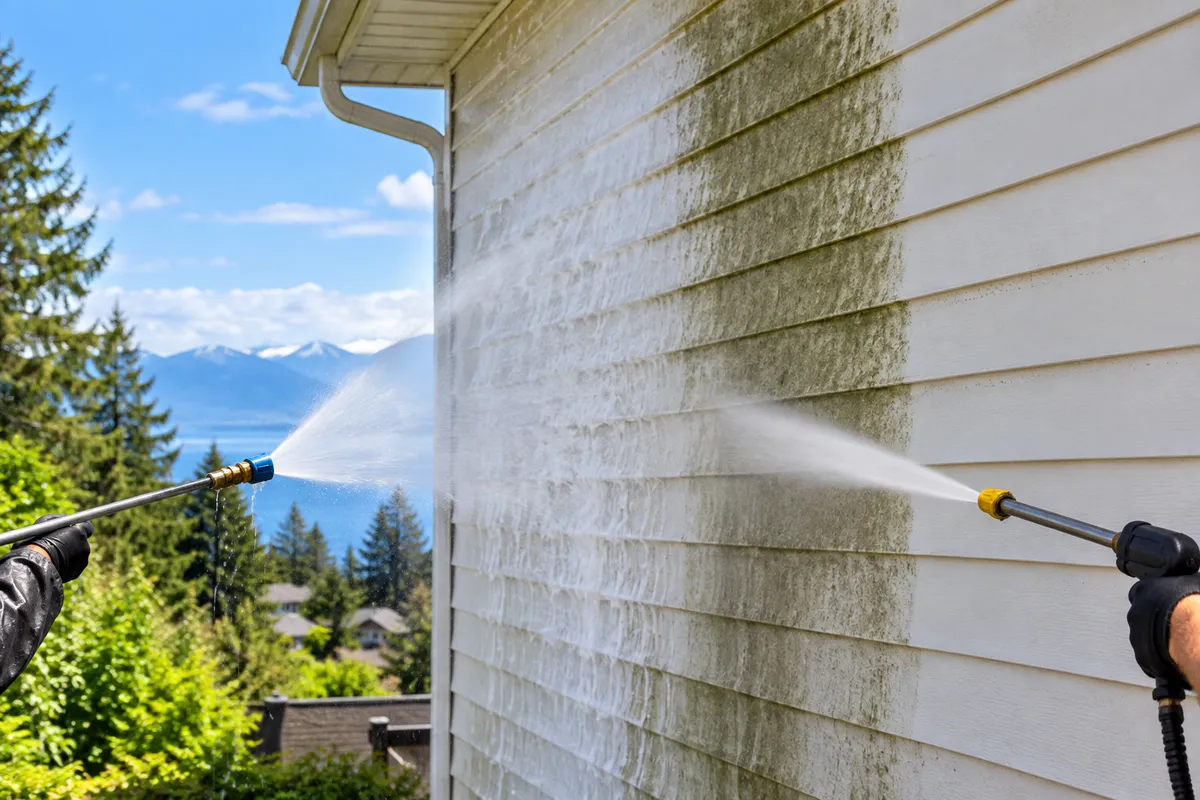
House Washing in Bellingham: Soft Wash vs Pressure Wash
By the end of a Bellingham winter, the north side of a lot of houses has turned a little green. Months of rain, short days, and shade from big evergreens give algae, mildew, and moss what they need to settle into siding, trim, and roof edges. Good house washing in Bellingham starts with choosing the right cleaning method for each surface, because the method that makes a concrete driveway look new can damage cedar siding or old paint.
Soft washing uses low pressure and a cleaning solution to kill and lift organic growth, so it's the usual choice for siding, painted trim, and roofs. Pressure washing uses high-pressure water to scour hard surfaces like concrete, pavers, and some masonry. Most homes need both, on different parts of the property. In Bellingham, wherever the wash water ends up also has to follow city rules.
1. What soft washing actually does
Soft washing isn't just a gentler spray. The cleaning solution does most of the work. It's applied at low pressure, left to sit so it can break down the algae, mildew, and grime on the surface, and then rinsed off. Because the growth is treated instead of blasted, siding and paint don't take the beating that high pressure gives them. It's how we approach siding and roofs as part of our residential exterior cleaning.
That's why soft washing is the standard approach for:
Painted and stained wood siding, including cedar
Vinyl and fiber cement siding
Painted trim, fascia, and soffits
Roofs with moss or algae streaking
Gutter exteriors
2. What pressure washing is built for
Pressure washing depends on force. It's the right tool for hard, durable surfaces where grime has worked its way into the texture: concrete driveways, sidewalks, patios, and some types of stone. It also works on decks and fences, as long as the operator adjusts the pressure and technique to the wood.
The trouble starts when that same force hits a house. High pressure can drive water behind lap siding, lift paint that was only slightly loose, and fuzz or gouge soft woods. On an older Bellingham home, any of those can turn a cleaning job into a repair job.
3. Soft wash vs pressure wash, side by side
Soft washing | Pressure washing | |
|---|---|---|
How it cleans | Cleaning solution breaks down growth, low-pressure rinse | High-pressure water physically removes grime |
Best surfaces | Siding, painted trim, roofs, gutter exteriors | Concrete, driveways, sidewalks, patios, some masonry |
Handles organic growth | Treats algae, mildew, and moss at the source | Removes what it can reach on the surface |
Risk to paint and wood | Low when done correctly | Higher, especially on soft wood and older paint |
Typical use around a home | The house itself | Hardscape around the house |
4. Why Bellingham homes need a careful approach
Our climate is the main reason. Siding here stays damp for long stretches, and the shaded sides of a house may barely dry out between fall and spring. Growth that's allowed to sit keeps moisture against the surface, which is one of the reasons exterior paint here breaks down the way it does. We cover that in more detail in how rain, moss, and moisture affect exterior house paint.
Age of the housing matters too. Neighborhoods like the Lettered Streets, Columbia, and Fairhaven have plenty of older homes with many layers of paint on them. Homes built before 1978 may have lead-based paint in some of those layers. Aggressive pressure washing can knock loose paint chips and send them into the yard, which is a problem on its own. On an older home, ask any contractor how they handle lead-safe work before the water goes on.
5. Where the wash water goes (and why the City of Bellingham cares)
This part gets skipped a lot. The City of Bellingham's stormwater guidance says discharging anything other than rain into the storm drain, including pressure wash wastewater, is prohibited under Bellingham Municipal Code 15.42, as well as state and federal law. Storm drains are meant to carry rain and nothing else, and wash water full of detergent, grime, and paint flakes isn't rain.
According to the city, wash water should go to a sanitary sewer drain or to a vegetated area where it can soak into the ground. The city also recommends:
Sweeping and dry-cleaning surfaces before washing
Using storm drain covers, tarps, berms, or sandbags to contain runoff
Moving the containment as the work progresses so it keeps catching the water
Filtering wash water that contains solids or petroleum products before disposal
The city also flags buildings constructed or renovated between 1950 and 1979, which may contain PCBs. Wash water from those buildings can't go into storm drains and may need hazardous waste disposal. For business owners, the city offers free pressure wash water reclaim kits through its Business Pollution Prevention Program. The city's pressure washing page has the details.
A driveway rinsed straight into the gutter out front is exactly what those rules are written to stop.
6. Signs it's time for a house wash
Green or black streaks on the north or shaded sides of the house
A chalky film on painted siding when you run a hand across it
Dark streaks running down the roof or along the gutters
Moss collecting along roof edges, trim, or the bottom row of siding
Mildew spots on soffits and porch ceilings
You're planning to repaint in the next season
That last one matters more than it seems. Paint can't bond to dirt, chalk, or mildew. A proper wash is part of prep for exterior painting, not an optional extra, and it's one of the first items on our exterior painting checklist for Bellingham homeowners.
7. What affects the cost of a house wash
Every house is different, so a real quote comes from looking at the property. These are the things that make a job smaller or bigger:
Factor | Lighter job | Bigger job |
|---|---|---|
Size and height | Single story, simple footprint | Two or more stories, lots of corners and gables |
Amount of growth | Light surface film | Heavy algae, moss, or years of buildup |
Surfaces included | Siding only | Siding, roof, gutters, deck, and driveway |
Access | Open yard, easy reach | Steep lots, tight side yards, dense plantings |
Water containment | Lawn or planting beds to absorb runoff | Runoff near storm drains that needs extra containment |
8. What to ask before you book
A few questions will tell you a lot about how a company works:
Which method will you use on my siding, and which on my concrete?
What cleaning solution do you use, and how do you protect plants and landscaping?
Where will the wash water go, and how do you keep it out of storm drains?
My house is older. How do you handle paint that may contain lead?
Are you licensed, bonded, and insured in Washington?
If my paint is already failing, will you tell me before you wash, or after?
A contractor who answers these clearly, without hurrying you along, is usually one who does careful work.
Frequently asked questions
Is it okay to pressure wash house siding? High pressure is usually the wrong tool for siding. It can push water behind the boards, damage soft wood, and strip paint. Soft washing is the standard method for siding because the cleaning solution removes the growth and only a low-pressure rinse is needed.
Can I use my pressure washer as a soft wash system? Some homeowner pressure washers have low-pressure nozzles or detergent settings, but soft washing depends on the right cleaning solution, dwell time, and a thorough rinse, not just less pressure. If you try it yourself, keep the pressure low, test a hidden spot first, and keep the runoff out of the storm drain.
How often should a house be soft washed? It depends on the house. Homes under heavy tree cover, with a lot of shade, or near water tend to grow algae and moss faster. A good rule is to wash when you start seeing green on the shaded sides, and always before repainting.
What is the average cost to soft wash a house? Cost depends on the size and height of the home, how much growth there is, which surfaces are included, and how easy the property is to work around. An on-site look is the only way to get an accurate number, and most companies, including ours, provide free quotes.
Book house washing in Bellingham and Whatcom County
Next Step Painting provides residential and commercial pressure washing and soft washing in Bellingham and nearby communities, including Ferndale, Lynden, Blaine, Birch Bay, Sudden Valley, Everson, Nooksack, Sumas, Deming, Acme, Glacier, Maple Falls, Geneva, and Lummi Island. We're licensed, bonded, and insured (WA Contractor License #NEXTSSP812L1). If you're planning house washing in Bellingham ahead of an exterior repaint, or just want the green off the north wall, request a free quote or call (360) 255-3183.